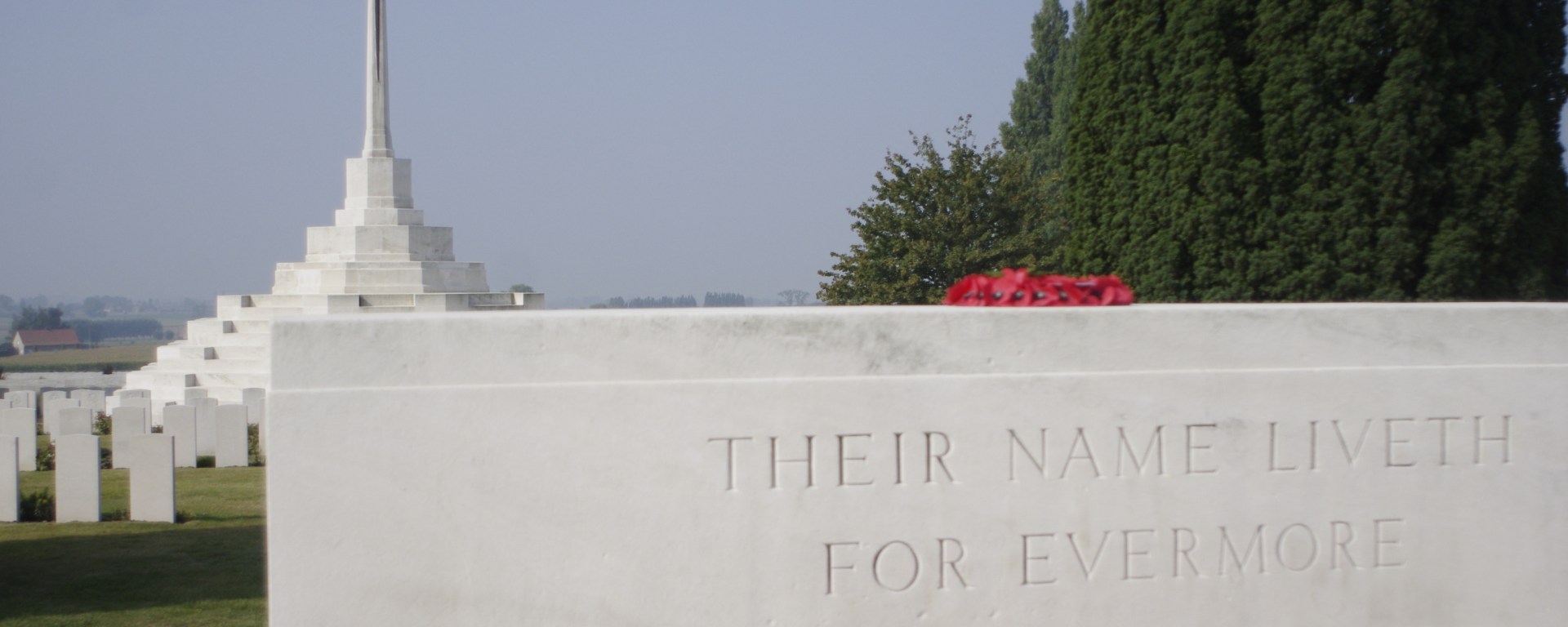
A somber day to be sure. We set out early to meet up with Henri, our Belgian guide, of Far West Tours, for a full day of touring World War I battlefields around Ieper (“ee-pra”; called Ypres during WWI, but now known by its Flemish name; commonly called Wipers by the British troops in WWI), Belgium. For me, it was a day of learning; I am not a “war” scholar in terms of battle maneuvers and strategies.
- There were three battles around Ypres. The first one, the most significant, was in 1914, the second in 1915 — both instigated by the Germans — and the last in 1917 (also called the Battle of Passchendaele), instigated by the Allies.
- Do you know what a salient is? It’s a “bulge,” a line that pushes into enemy territory. It’s surrounded on three sides by the enemy and therefore very dangerous for those inside the salient.
- Ypres was so important because it was considered the last area where either side could launch an effective offensive.
 Our first stop was the Welsh Memorial Park. It was dedicated in 1914. I especially loved that the Dragon sits atop a cromlech; one of my favorite places in Wales is the
 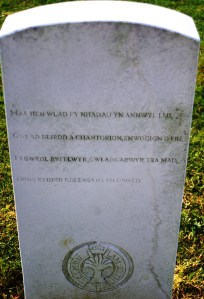 Pentre Ifan dolmen, and the stone form reminds me of that. Several Welsh units fought in the Battle of Passchendaele, including the Royal Welsh Fusiliers (see the previous post on our grandfather’s service with the Fusiliers). It was moving to see the regimental coats of arms and the many stones carved in Welsh. The headstone here reads, roughly, “The land of my fathers is dear to me, a country of poets and singers, famous men of renown and brave warriors, patriots, over freedom shed their blood.”
Our next stop was Langemark German Military cemetery. There is a large grassy area there, which you then find out is the mass grave of nearly 25,000 Germans. I was so stunned by that, that there were mass graves here at all and that this one area contained so many soldiers, I felt a bit disconnected the rest of the time there. I felt further disconnected when I found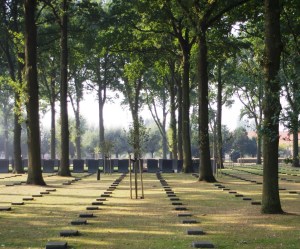 out that Hitler had visited this very cemetery in 1940. Even though 76 years separated us, I didn’t want to be anywhere he had been; it was a strange but strong reaction. The cemetery has large, stately oaks (the national tree of Germany) throughout; when visiting other cemeteries later, I realized that the Allied (Commonwealth) cemeteries used flowers and shrubs, but no trees, with gleaming white marble markers. Langemark was shaded and silent, with flat, dark markers…and quite moving.
From there, we moved on to the St Julien Canadian Memorial, site of the striking Brooding 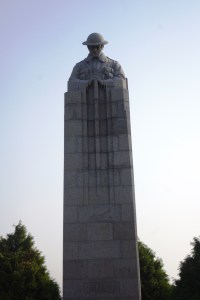 Soldier monument.The monument honors the Canadians in the Second Battle of Ypres who were subjected to the first chlorine gas attack in the war, on April 22, 1915. It was also the first conflict of the war the Canadians were involved in. The Brooding Soldier is surrounded by gardens of tall cedars trimmed into the shape of artillery shells and low cut cedars trimmed to look like shell explosions.The soil here was brought from many areas of Canada; I found this particularly touching. In addition to the link our family has to the Welsh who fought in World War I, we also have, on our father’s side, a link to Canadians who fought in this war. My father’s parents were Canadian, with the family tracing back several generations. Several of our great uncles served; it was hard not to personalize this particular memorial for that reason.
We then went to the Passchendaele Museum, which records the Third Battle of Ypres, or Passchendaele, and its futility. The Battle was put in motion by the British, who wanted to cut off a railway supply line for the Germans; however, because of winter approaching and the very wet weather, equipment became bogged down in the mud. The battle continued for about a month, with about 400,000 men killed for little gain. The archive at the museum is a bit overwhelming, containing letters, photos, watches, glasses, and all other sorts of personal belongings that make it all very personal. Sometimes the mind is a bit more comfortable with abstracts…this museum makes such abstraction nearly impossible. There was also an area where you could walk through trenches…I was a bit overloaded and skipped that.
After lunch, we went to In Flanders Field Museum. It’s quite a remarkable museum, complete with off-tone ominous music and constant tolling of bells. As with the Passchendaele Museum, it all was a bit much. Don’t get me wrong, it’s an important museum and I would recommend it…just perhaps on its own day.
Back outside, we went to Hill 60, a man-made rise 60 meters above sea level, and thus a valuable piece of “high ground.” Much of the fighting here was underground: t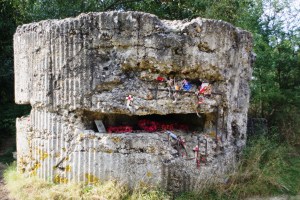 unnels and mines were used heavily here. When mines blew or tunnels collapsed, the dead were left where they were — and remain there today. The area is marked with craters from explosions, although they look almost “soft” now with the green grass covering them. There are also several bunkers still in the area. It’s easy to see how well-built they are, even 70 years later.
From there, we went to Essex Farm Cemetery, which is inside the John McCrae Memorial Site; he is the author of “In Flanders Fields.” This cemetery is small compared with others; the bunkers McCrae and other physicians and medics used is still there.
Our last stop was the Ypres Rampart Cemetery, which, as the name says, is literally on the city wall ramparts, overlooking the Kasteelgraacht, or moat, surrounding the city. It is a peaceful, beautiful spot; one that I was glad we ended on after this long day.
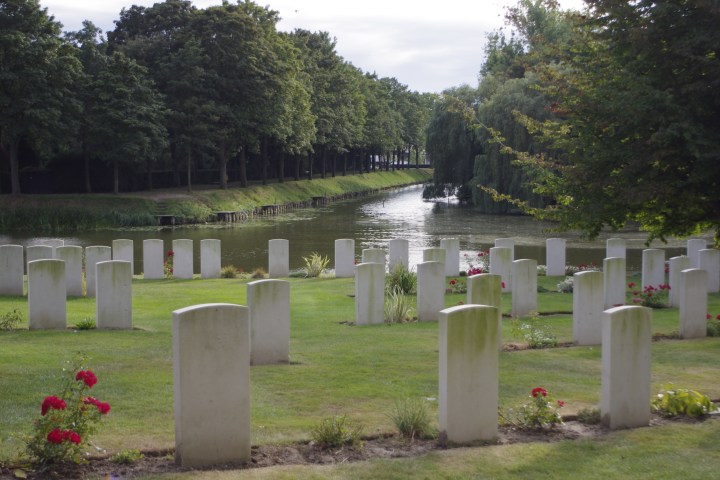
It is humbling, sad, melancholy to think of the many, many soldiers who died just in this area of Ypres. Add the other many battles and the civilians and it becomes almost more than the mind can grasp. The sheer multitude of memorials, monuments, and cemeteries is staggering and you can’t help but think that they’ll serve to remind us that one day we will stop all the madness. Until that time, however, these places are important to visit…but perhaps not all in one day.
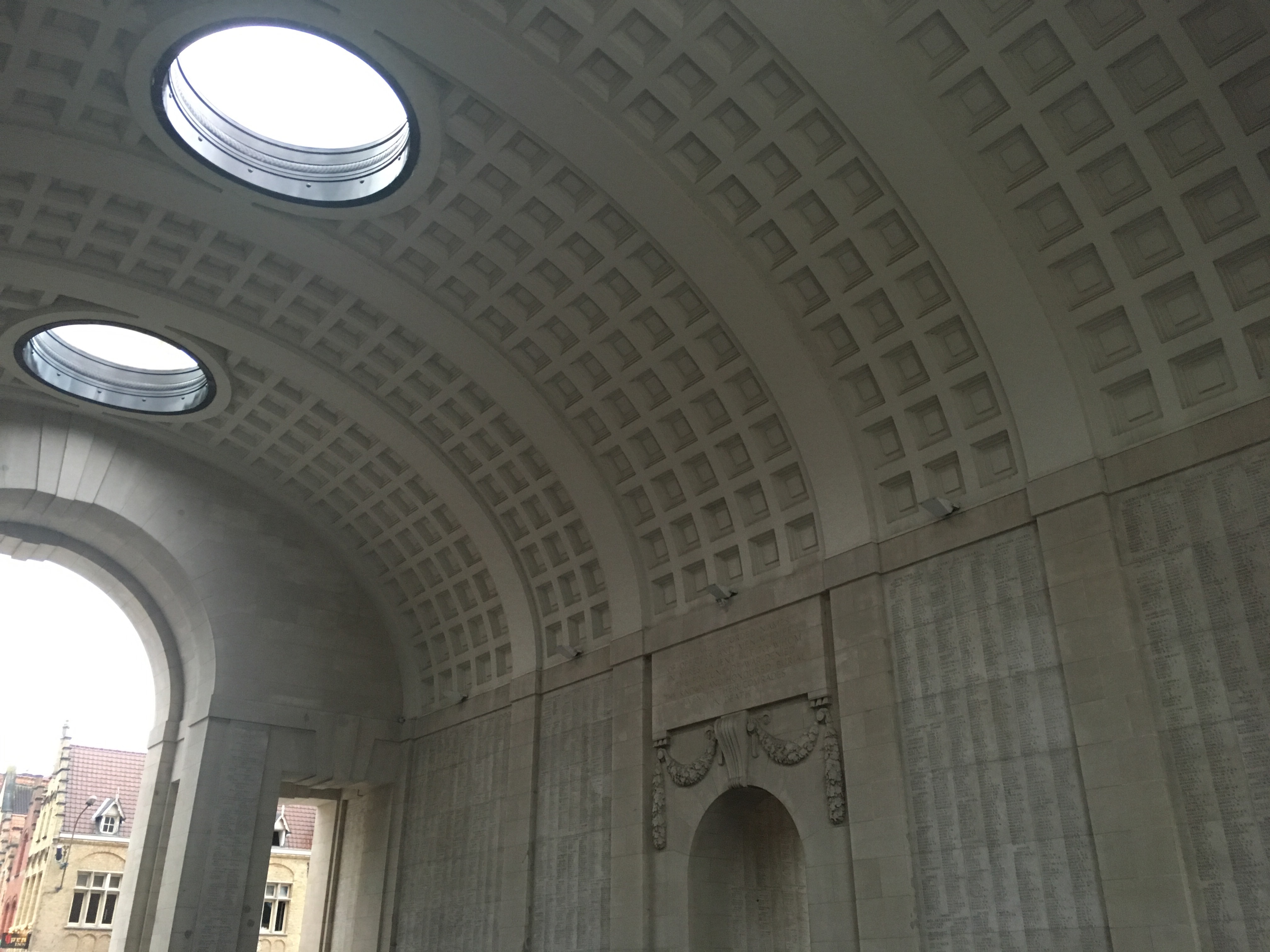 Our last stop today was at Menin Gate in Ypres for Last Post. Remarkable. Every night at 8:00 since 1928, the road through the massive arched gate is closed to traffic and buglers play the Last Post. The only time the daily ceremony did not take place was during German occupation during World War II (the ceremony took place in England during that time).
The memorial honors the missing, who have no known graves… 54,395 Commonwealth soldiers who died in the Salient but whose bodies have never been identified or found. Very sadly, remains of WWI soldiers are still found in the Ypres area when new construction is undertaken and the land is disturbed.
The inscription at the memorial reads:”Here are recorded names of officers and men who fell in Ypres Salient, but to whom the fortune of war denied the known and honoured burial given to their comrades in death.”
Here is a haunting painting that depicts the Menin Gate and the soldiers who passed through it: http://img.aasd.com.au/45611972.jpg
 Rhodio
