
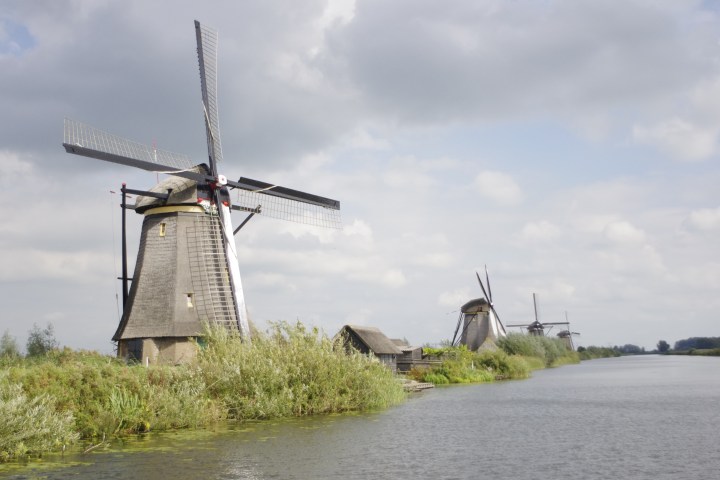
 Traveled up to Delft, the Netherlands, today. On the way, we stopped at the Kinderdijk windmills, a UNESCO World Heritage Site, which is also the largest grouping of working mills in the world. It is incredibly picturesque! The Netherlands is, in general, about 20 feet below sea level; the windmills are an ingenious — and intricate — method of controlling water levels. It’s important to keep the water levels stable as a means to keeping land from sinking. This system of 19 windmills was built around 1740 and is the largest concentration of old windmills in the Netherlands.
I knew that “kinder” meant “child,” but couldn’t figure out what the name had to do with 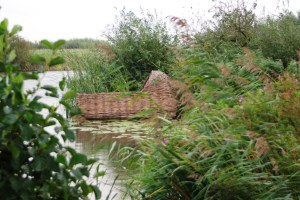 windmills. The story is that in the 1400s the area flooded. Someone went out to the area to see if anything could be saved and found a wooden basket, or cradle, floating on the canal. Not only that, but a cat was on the cradle, balancing it so that no water could get into it. The infant inside was safe and dry.
I learned quite a lot at this site. First, I didn’t realize that a miller and his family lived inside the windmills. Of course, this makes perfect sense, just as with lighthouses, that a miller would be onsite to maintain the mills, adjust the sails, or stop or start the mill depending on the water level. The living spaces were tiny, and it was amazing that the windmill itself was relatively quiet inside, even with the sails in use.
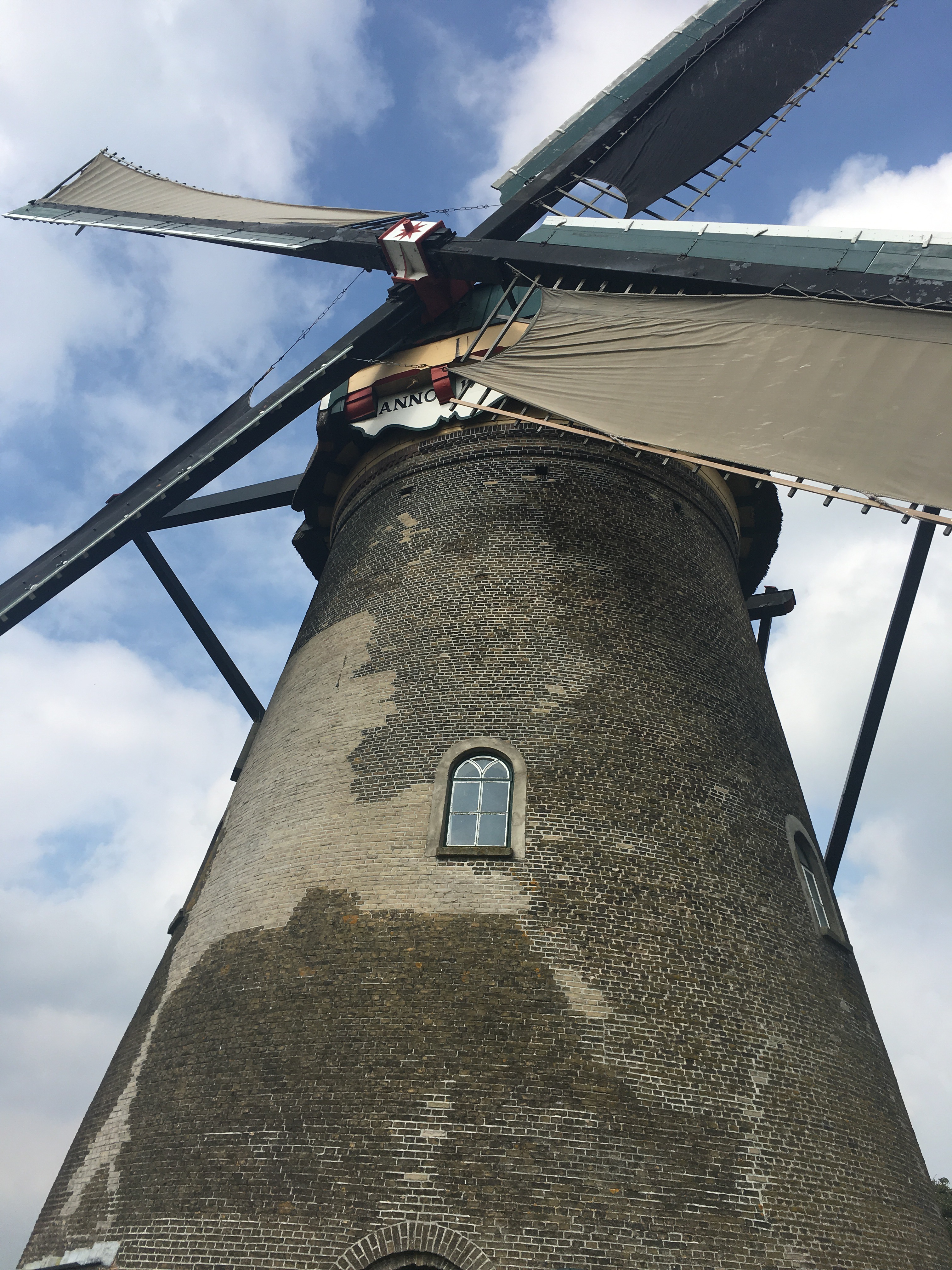 The sails themselves are massive. It was a bit disconcerting to walk around when the sails were in motion. The sound is incredible. These mills with very long sails are called grondzeilers or “ground sail windmills” because they almost touch the ground. The whole upper section of the mill can be turned by a manual crank inside; this is known as “winding.” Helpful when the wind changes directions! Some of the mills are in a straight line on the canal (but have more space between them); some are staggered (and closer together) to ensure the sails catch the wind. Two of the mills are octagonal. I’d thought these were the newest of the group, but they’re actually among the oldest. Eight of the mills are brick (built in 1738), eight are thatched (built in 1740), two are stone (b
 uilt in 1760); one that was wood and built in the 1500s burned down in 1997 (it’s been restored).
The mills were last used during World War II, but are still functional and could be used today if needed.
…By the way, you can rent some of these mills and stay there!
 Rhodio