Amazingly, I’m not jet lagged.
 This is our first morning in Nairobi, and it started out perfectly when a local cat—Jarvis—greeted us on the porch. We are staying at Rosslyn Academy for 2 nights; Laura’s niece works here. It’s been great to have a comfy place to crash!
We’d been warned that the Academy was adding a patio outside the room, but YIKES! 8 AM and the banging and pounding started. Plaster falling off the ceiling type of pounding.
It was a cool morning, and our driver Paul picked us up at 9:30, passed a big new mall, US style—many levels, tons of stores. It’s called the Village Market. We had dinner there later.
Driving through town, I saw plant and flower vendors everywhere, selling everything from petunias to cut flowers. The brightly colored baskets and pet beds, made in Masai colors, dotted the sides of the roads. It’s an interesting city, a contrast of abject poverty and new construction of high-rise apartments and office buildings. It was hard to tell them apart—billboards and advertising appear right on the buildings. My travel mate Laura says it’s very much like Paraguay. This includes the driving, which is of the “traffic lanes are just a suggestion” variety. I stopped looking out the front window.
To add to the seeming chaos, there’s a gas shortage right now. The president is out of the country and only he can sign a bill that will remedy it all. Lines to get gas snaked around the block.
Tall concrete walls, barbed wire on top of the walls, and the army patrolling the streets with machine guns makes for an interesting feel.
We drove by Kibera, an area in Nairobi that, well, is an urban slum. It’s massive, nearly a square mile. It’s not the largest slum in Kenya, but is apparently the largest urban slum in Kenya. Paul told us there were about 1 million people living there. The Kenyan government owns the land; people live in mud-walled, corrugated metal roofed, 12 × 12 shacks.
The David Sheldrick Wildlife Trust
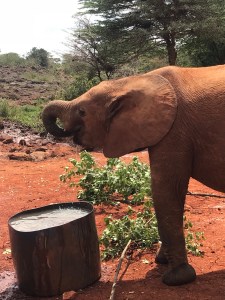
Our first stop was to David Sheldrick elephant orphanage—Paul has been many times but says “My eyes are not filled up yet” with seeing young elephants rescued from across the country.
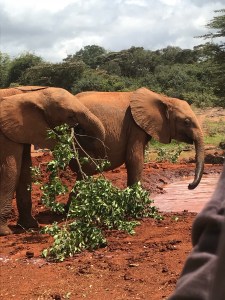 One of the elephants was rescued from the Masa Marai because its trunk had been caught in a snare; its trunk is healing nicely. Some were just 1 month old and did not yet have teeth to eat tree leaves. So the Trust rescues and feeds them. They will reintroduce the elephants into into existing, wild, herds of elephants, but it’s a slow process.
Human-wildlife conflict is the major cause of orphaned elephants, whether it’s the land for development or the ridiculous and disgusting Ivory/rhino horn trade. These are not necessary for human existence: BOYCOTT!
The Trust also sponsors mobile vet and antipoaching teams. Please visit to support this great place.
Went to the giraffe sanctuary next—meh. Ok if you’re not going to see any giraffes anywhere else.
Karen Blixen: a tremendous legacy
OK, I admit it: I’ve never seen “Out of Africa” the movie. Never even wanted to read the book, until now. Who knew Karen, a large suburb of Nairobi, was named after her? Or that she valiantly tried to keep her business (coffee plantation) afloat after her husband went on Safari for years at a time, or that she instituted health care for her workers and has many clinics named after her?
We went to the restaurant next to her home; this is on land where coffee was formerly produced. It was a lovely day; we sat outside at tables on the lawn and had a tasty lunch of chicken Marsala and lemon chicken. 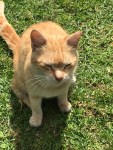
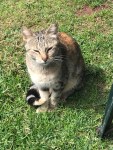 As with the morning, we were visited by two “property” cats that appeared to be littermates. It’s been so nice to get these “kitty fixes” since my Bryth died earlier this year.
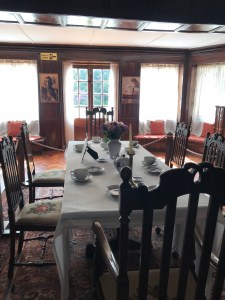 From there, we went to the house Blixen lived in. It’s an ordinary enough house and was on the property when she and her husband bought the land. Thick block walls for coolness, one story. Blixen was apparently an artist before leaving Denmark for Africa. Several pieces of her artwork are in the house, and I rather liked them.
This is not the only story told of colonial and postcolonial Africa, and it certainly takes into account only one person’s experience. But her books are going on my “to be read” list.
 Rhodio